
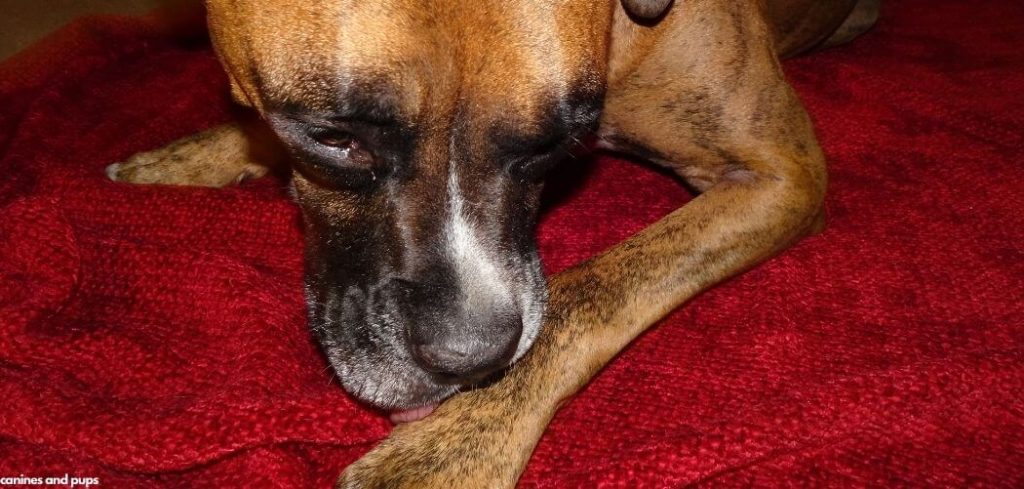
Occasional grooming of the paws is normal, but repeatedly returning to the same dew claw, chewing intensely, or suddenly becoming focused on one nail is more likely to indicate that something is bothering the area.
Dew claws can be particularly prone to problems because they do not usually receive the same wear as the other nails.
They can become overgrown, catch on surfaces, split, or break, potentially exposing the sensitive tissue inside the nail. A dog may then lick or chew the affected claw because it hurts or feels irritating.
Table of Contents
Dog Chewing on Dew Claw: Why It Happens
A dog may chew on its dew claw because the claw or surrounding skin is uncomfortable. This can occur when the dew claw is too long, cracked, partially broken, irritated, or infected.
The nail itself contains blood vessels and nerves within the quick. When a nail is damaged deeply enough to expose this tissue, it can be quite painful. Dew claws are also more susceptible to breaking because they do not normally bear weight or wear down against the ground.
However, chewing does not automatically mean the dew claw is broken. Problems affecting the skin between the toes or around the nail can also cause licking and chewing, so the entire paw should be considered.
Dog Dew Claw
A dog’s dew claw is the extra nail located higher on the inside of the front leg and, in some dogs, on the hind legs. Front dew claws are commonly attached by bone and can help provide stability and traction during movement.
Because dew claws may not wear down naturally as much as the other nails, they can become overgrown, cracked, or caught on objects.
Regularly checking and trimming the dew claw can help prevent problems. A dog may lick, chew, or suddenly yelp when a dew claw becomes too long, broken, or injured.
Redness, swelling, bleeding, discharge, persistent licking, or difficulty walking can indicate an injury or infection that requires veterinary attention.
Dog Chewing on Dew Claw: Common Causes
Overgrown Dew Claw
An overgrown dew claw is a common reason a dog may start chewing at the nail.
Because dew claws receive little natural wear, they may grow longer than the other nails.
A long claw can curve toward the paw or catch on carpets, vegetation, furniture, and other surfaces. Long nails are also more likely to become caught and break.
If the claw is simply longer than the others but the surrounding area looks normal, overgrowth may be contributing to the behavior.
Related: Dew Claw Problems in Dogs (Causes, signs and treatment)
Broken or Cracked Dew Claw
A cracked or broken dew claw can cause sudden chewing. Dogs can break nails by snagging them on carpet, upholstery, grass roots, or other objects.
A nail can also bend backward during jumping or an awkward landing. A torn nail may cause sudden pain, licking, chewing, limping, or holding the paw up.
A partially broken claw may be difficult to see if the dog will not allow the paw to be handled.
Related: Dog excessively licking paws and legs (Why it happens)
Exposed Quick
If the quick has been exposed, the dew claw can become especially painful.
The quick contains blood vessels and nerves, so damage to it can cause pain and bleeding.
Because the quick is living tissue, a significant injury can also create an opportunity for infection.
A dog may repeatedly chew at the claw because the exposed area feels painful or irritating.
Nail Infection
An infection around the dew claw can make a dog focus intensely on the area.
Possible signs include redness, swelling, warmth, discharge, an unpleasant odor, tenderness, or persistent licking and chewing. Infections involving the foot can also cause lameness or swelling.
Chewing can further irritate already inflamed tissue and make the area more vulnerable to additional trauma.
Related: Dog chewing nails (Here’s why)
Irritated Skin Around the Dew Claw
Sometimes the nail itself is normal, but the skin around it is irritated.
Inflammation between the toes or around the foot can cause dogs to lick and chew their paws.
Interdigital cysts and other inflammatory skin conditions can be painful or itchy and may cause persistent chewing.
If you cannot find an obvious nail abnormality, look for redness, bumps, swelling, moisture, or discharge around the surrounding skin.
Foreign Material
A small piece of grass, plant material, dirt, or another foreign object can become caught around the paw or nail.
This may cause localized irritation and prompt a dog to repeatedly chew at one particular area.
If swelling or pain develops and the source is not obvious, a veterinarian may need to examine the paw more closely.
Nail Trauma
A dew claw may become painful after an otherwise minor accident. The dog may have caught the claw on something while running, playing, climbing, or moving through vegetation.
Sometimes the initial injury is not noticed because dogs may continue walking normally despite a painful nail.
A sudden change from normal behavior to persistent chewing is particularly suggestive of a recent irritation or injury.
Multiple Abnormal Nails
If your dog is chewing one dew claw but several other nails are also becoming brittle, misshapen, or repeatedly breaking, an underlying nail disorder should be considered.
Symmetric lupoid onychodystrophy, for example, is an uncommon condition that typically affects multiple or all nails and can cause abnormal nail growth, breakage, and nail loss.
This is different from a single dew claw that breaks after catching on something.
Dog Chewing on Dew Claw but Not Limping
A dog can chew on a dew claw without limping. Not every nail problem produces obvious lameness, particularly when the injury is mild or the dog can still put weight on the foot. Dogs can also mask pain surprisingly well.
If your dog repeatedly returns to the same dew claw even though it is walking normally, examine the claw and surrounding skin for excessive length, cracks, swelling, redness, discharge, or other changes.
Persistent attention to one nail is more meaningful than occasional paw grooming.
Dog Chewing on Dew Claw and Licking Paw
Chewing and licking the same dew claw may indicate that the area is painful or irritated.
A damaged nail can cause both behaviors, but inflammation of the surrounding skin can do the same.
If the paw is becoming moist, red, swollen, or sore from repeated licking, the problem can become increasingly difficult to resolve without addressing the original cause.
Interdigital inflammation and infection can also lead to persistent licking and chewing of the foot.
Dog Chewing on Dew Claw and Bleeding
If your dog is chewing on a dew claw that is bleeding, the nail may have been cracked or torn deeply enough to damage the quick.
A broken nail can bleed because the quick contains blood vessels. Significant nail injuries can also be very painful.
A bleeding, partially detached, or severely damaged dew claw should be assessed by a veterinarian, particularly if the bleeding persists or the dog is very painful.
Dog Chewing on Dew Claw After a Nail Trim
Some dogs may briefly lick or pay attention to a dew claw after nail trimming because the area has been handled or feels different.
However, persistent chewing after a trim can indicate that the nail was cut too close to the quick or that the claw was damaged during trimming.
The quick contains nerves and blood vessels, so cutting into it can cause pain and bleeding.
If the dog continues to chew the claw, develops bleeding, or appears painful, the nail should be examined rather than assuming the behavior is simply normal grooming.
Related: Dog excessively licking front legs (Here’s why)
When to Call or Visit the Vet
Contact your veterinarian if your dog is chewing on a dew claw and you notice:
A cracked, split, torn, or partially detached nail
Bleeding from the dew claw
Significant redness or swelling
Pus, discharge, or an unpleasant odor
A dew claw that appears unusually dark, malformed, or damaged
Persistent or worsening pain
Limping or holding the paw up
Repeated chewing despite the nail appearing normal
Several nails becoming brittle, misshapen, or repeatedly breaking
A swollen or painful area between the toes
A wound or suspected foreign material around the claw
Immediate veterinary assessment is needed when the nail is badly torn, the dog cannot comfortably use the foot, bleeding continues, or swelling and pain are increasing.
Dog Chewing on Dew Claw: Treatment
Treatment depends on what is causing the chewing. The veterinarian can examine the dew claw, quick, nail bed, surrounding skin, and rest of the paw to determine whether the problem is overgrowth, trauma, infection, inflammation, or an underlying nail disorder.
A damaged portion of nail may need professional trimming or removal, while infection or inflammation may require targeted treatment.
If several nails are abnormal or the problem repeatedly returns, additional testing such as skin or nail evaluation, cytology, culture, or other diagnostic testing may be recommended depending on the findings.
Key Takeaway
A dog chewing on its dew claw is often reacting to something that feels uncomfortable.
An overgrown, cracked, broken, or irritated dew claw can cause a dog to repeatedly lick or chew the same nail.
Occasional grooming is not necessarily concerning, but persistent chewing of one dew claw—especially with bleeding, swelling, redness, discharge, pain, or limping—should not be ignored.
If the claw looks normal but your dog continues focusing on it, the surrounding paw may also need to be examined for another source of irritation.


