
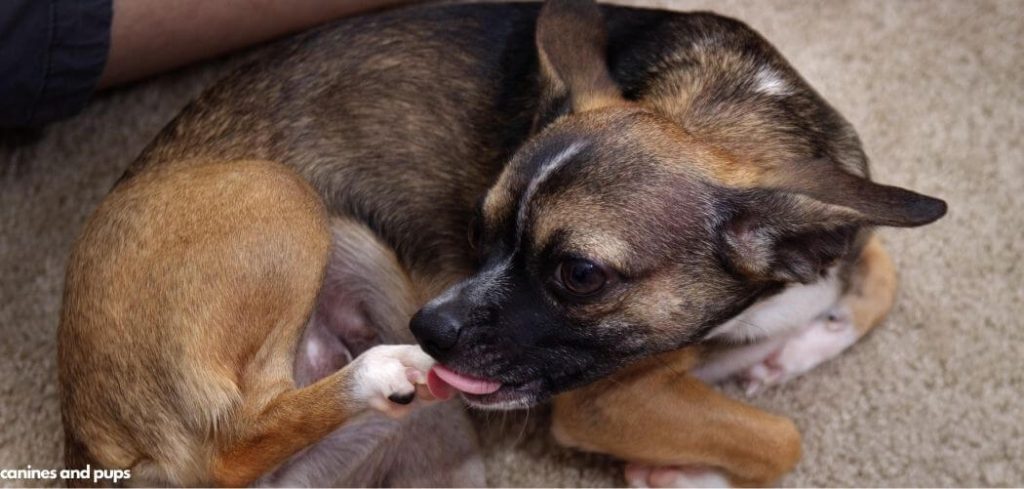
When a dog suddenly starts chewing its leg, the behavior can be surprising, especially if it has never done it before.
A dog may repeatedly lick, nibble, or bite one particular area, sometimes focusing on the lower leg, paw, ankle, or a spot higher up the limb. The sudden change usually means something about that area has caught the dog’s attention.
The meaning depends on what else is happening. A small skin irritation may cause temporary chewing, while a broken nail, wound, insect bite, foreign object, infection, or painful injury can produce more persistent behavior.
Some dogs may continue walking normally even when a leg is uncomfortable, so the absence of obvious limping does not necessarily rule out a problem.
Table of Contents
Dog Chewing Leg Suddenly: Why It Happens
A dog may suddenly start chewing its leg when it experiences a new source of itching, irritation, pain, or an abnormal sensation in the limb. Dogs may respond to these sensations by licking or biting the affected area.
Sometimes the source is visible on the skin, such as redness, a wound, swelling, or a parasite. In other cases, the problem can involve a joint, muscle, tendon, nerve, or deeper tissue without producing an obvious external mark.
Sudden lameness in dogs can result from problems involving the nails, soft tissues, joints, bones, or nerves.
Dog Chewing Leg Suddenly: Common Causes
Minor Skin Irritation
A small area of irritated skin can make a dog suddenly begin licking or chewing its leg. Grass, dirt, moisture, friction, or contact with an irritating substance can contribute to localized discomfort.
The affected area may look slightly pink or irritated at first. Repeated chewing can then damage the skin further, making the area more inflamed.
Related: Dog excessively licking paws and legs (Why it happens)
Insect Bite or Flea Irritation
An insect bite can cause sudden localized itching, causing a dog to immediately focus on one area of the leg.
Flea allergy can also cause dogs to bite, lick, or chew their hind legs.
Dogs with flea allergy dermatitis may develop intense itching, hair loss, scabs, and secondary skin infections. Importantly, a flea does not always need to remain on the dog for the itching to continue.
A Broken Nail or Paw Problem
Sometimes a dog appears to be chewing its leg when the actual source of discomfort is the paw or one of the nails.
Broken nails can be painful, while problems between the toes can cause licking, biting, swelling, and sometimes limping.
A dog may focus intensely on the affected foot without showing a dramatic change in walking. Sudden lameness commonly occurs with problems such as broken nails and soft-tissue injuries.
Related: Dog excessively licking front legs (Here’s why)
Foreign Object
A small foreign object can become embedded in the paw or skin and cause sudden chewing. Grass awns, splinters, burrs, or other plant material are possible examples.
When a foreign object becomes lodged between the toes or in nearby tissue, the resulting inflammation can be painful and may eventually become infected.
Foreign-body reactions are recognized contributors to some painful lesions between a dog’s toes.
Wound or Puncture
A small cut, puncture, scrape, or bite wound can cause a dog to suddenly begin chewing one area of its leg. Small wounds can sometimes be difficult to see beneath thick fur.
Puncture wounds are particularly important because the surface opening may appear minor while deeper tissue is affected.
Infection can develop afterward, potentially leading to swelling, warmth, pain, or discharge.
Skin Infection
Bacterial or yeast-related skin problems can cause itching and irritation that leads to persistent licking and chewing.
The skin may become red, moist, crusted, have an unusual odor, or develop small bumps or sores.
Once a dog repeatedly traumatizes an itchy area, the resulting skin damage can make the irritation worse.
Interdigital Cyst or Furuncle
If the chewing is actually focused around the lower leg and paw, an inflamed lesion between the toes may be responsible.
Interdigital furuncles are painful inflammatory lesions that can occur between the toes.
Dogs may lick and bite at them, and affected dogs may also become lame. Some lesions are associated with foreign-body reactions or other underlying skin problems.
Muscle, Tendon, or Joint Injury
A dog may chew its leg because movement or pressure is uncomfortable even when the skin looks completely normal.
A strain, sprain, tendon injury, joint problem, or other soft-tissue injury can produce pain without an obvious wound.
Sudden lameness can result from injuries involving muscles, tendons, ligaments, joints, or bones.
Nerve-Related Discomfort
Less commonly, abnormal sensations caused by a nerve problem can lead a dog to focus intensely on a limb.
Nerve injuries can affect sensation and movement in a leg. In severe cases, dogs with nerve damage may even chew at an affected limb, particularly when abnormal sensation accompanies weakness or paralysis.
Pain That Is Not Visible on the Skin
Not every painful leg has an obvious external abnormality. Problems involving a joint, muscle, tendon, bone, or nerve may leave the skin looking normal.
This is one reason persistent or intense chewing should not automatically be assumed to be a behavioral habit.
A veterinary examination may be needed to determine whether the discomfort originates from the skin or deeper structures.
Related: Dog excessively licking belly (Here’s why)
Dog Chewing Leg Suddenly but Not Limping
A dog can chew its leg without limping. Mild skin irritation, an insect bite, early infection, a small foreign object, or a localized nail or paw problem may cause chewing before a noticeable change in walking develops.
If the behavior stops quickly and the leg looks normal, the problem may be minor. However, repeated chewing, increasing attention to the same area, hair loss, redness, swelling, or sensitivity should prompt closer evaluation.
Dog Chewing Leg Suddenly and Licking
Chewing and licking the same leg often point toward itching, irritation, or pain in that area.
Allergies, fleas, skin infections, wounds, and lesions between the toes can all cause repetitive grooming.
If the dog is licking several legs or multiple areas of the body, a more generalized skin problem becomes more important to consider. If only one small area is being targeted, a localized problem may be more likely.
Dog Chewing Leg Suddenly and Limping
Sudden chewing accompanied by limping deserves more attention because the dog may be experiencing pain deeper in the limb.
Broken nails, soft-tissue injuries, joint problems, fractures, and dislocations are among the possible causes of acute lameness.
A veterinarian can determine whether the problem is coming from the paw, muscles, joints, bones, or nervous system.
Dog Chewing Leg Suddenly With Swelling
Swelling can occur with injury, inflammation, infection, or an abscess. A warm, painful swelling under the skin may indicate a deeper infection, while swelling around a joint can have several possible causes.
Sudden or rapidly increasing swelling, particularly when accompanied by severe pain, inability to use the leg, or a wound, warrants immediate veterinary assessment.
When to Call or Visit the Vet
Contact a veterinarian if your dog is suddenly chewing its leg and has any of the following:
Persistent or increasingly frequent chewing
Redness, swelling, heat, or obvious skin irritation
A wound, puncture, or suspected bite
Bleeding or discharge
A broken or damaged nail
A lump, sore, or draining area
Swelling between the toes
Significant pain when the leg is touched
Limping or reluctance to use the leg
Sudden severe lameness
Weakness or difficulty standing or walking
Repeated chewing that causes hair loss or open skin
Several areas of the body becoming itchy or affected
A suspected foreign object embedded in the paw or leg
Sudden severe lameness, inability to use the limb, severe or constant pain, or other major changes in walking should be treated as urgent problems.
Sudden severe lameness and severe or constant pain are among reasons for immediate veterinary attention.
Dog Chewing Leg Suddenly: Treatment
Treatment for dog chewing leg suddenly depends on what the examination reveals.
The veterinarian may examine the skin, paw, nails, joints, muscles, and nerves and may recommend tests such as skin cytology, bacterial or fungal testing, X-rays, or other imaging when appropriate.
A foreign object may need to be removed, an infected lesion may require targeted treatment, and an orthopedic or neurologic problem may require a different approach.
Key Takeaway
Dog chewing leg suddenly usually means the dog has noticed something uncomfortable in that area. Skin irritation, an insect bite, flea allergy, a broken nail, foreign object, wound, infection, or a deeper muscle, joint, or nerve problem can all be possibilities.
Occasional chewing that quickly stops may not indicate a serious problem, but persistent or intense chewing should not be dismissed as a habit.
Redness, swelling, wounds, limping, pain, discharge, or sudden difficulty using the leg are reasons to have the dog evaluated by a veterinarian.


